
Wine Label Design: Required Information and Design Tips
How do you design a wine label?
Design a wine label by starting with the information the law requires, then building the brand around it. In the United States, wine labels are regulated by the Alcohol and Tobacco Tax and Trade Bureau (TTB). Your label needs a brand name, a class or type designation, the alcohol content where required, the bottler or importer’s name and address, net contents, a sulfite declaration where it applies and the exact government health warning. Once those are placed correctly, your design choices, such as typography, color, illustration and paper, decide whether the bottle stands out on the shelf.
This guide covers the parts of a wine label, the mandatory information, design choices for the front and back labels, printing and finishes, the approval process and a checklist. Pros Inc designs labels, packaging and brand identities for small businesses from our office in San Diego. Label rules below come from TTB’s Anatomy of a Wine Label tool and the federal regulations in 27 CFR, read as of October 2026. This is general information, not legal advice; confirm your label with TTB or a qualified compliance professional before you print.
The brand label and the other labels
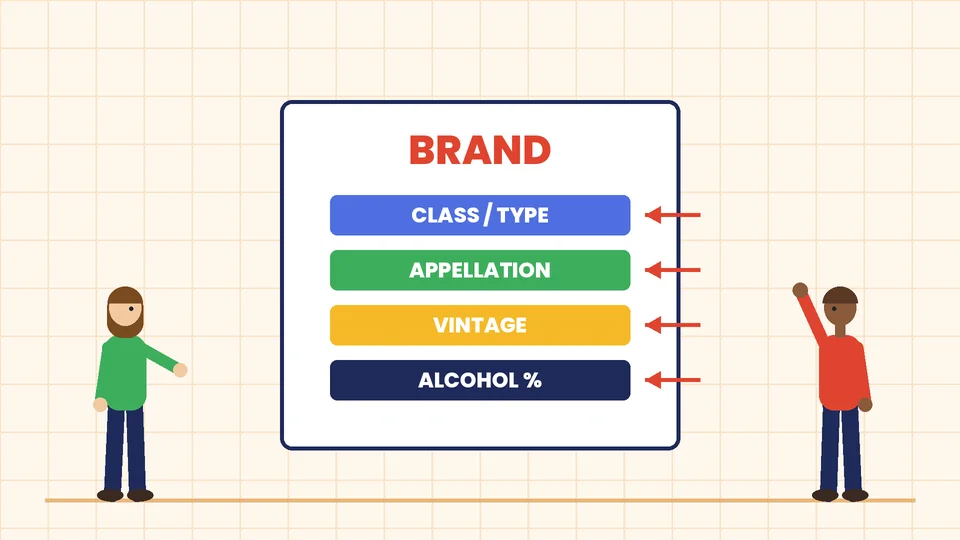
TTB’s Anatomy of a Wine Label tool splits a bottle’s labeling into the brand label and other labels. In practice, most wineries think of these as the front label and the back label.
- Brand label (usually the front). Carries the brand name and, where required, the class or type designation and appellation of origin together.
- Other labels (usually the back or a neck or strip label). Often carry the health warning, alcohol content, sulfite declaration, name and address, net contents, tasting notes and a barcode.
TTB’s wine labeling page also notes that its wine rules cover products such as cider and mead, not only grape wine, and it links a mandatory information checklist that is worth printing out before you start.
Mandatory information on a wine label
Here is what TTB’s tool lists, in plain terms.
Brand name. The name the wine is sold under. It must appear on the brand label, and it can’t mislead buyers about the wine’s age, origin or identity. A class or type on its own, such as “Chardonnay” or “White Wine,” can’t serve as the brand name. A fanciful name, such as a name for one wine in a line, is optional and doesn’t replace the class or type.
Class or type designation. Every wine needs one, such as “red wine” or “Sparkling Chardonnay.” A color on its own isn’t enough: TTB’s example is that “rosé wine” is a class or type, but “rosé” is not. If you name two or more grape varieties as the type on the brand label, you must show the percentage of each, and they must add up to 100%.
Appellation of origin. Where the grapes or other fruit were grown, such as a state, a county or an American Viticultural Area. It becomes mandatory in certain cases, including when the label names a grape variety as the type or shows a vintage date, and it must then appear on the brand label with the class or type.
Vintage date. The year the grapes were harvested. It can only be used on grape wines, and it requires an appellation of origin on the brand label.
Alcohol content. For wines over 14% alcohol by volume, a numerical statement is mandatory. For wines from 7% to 14%, it is optional if the label uses the type “table wine” or “light wine.” TTB notes that “ABV” is not allowed as the abbreviation in the mandatory statement, so write it out, for example “Alcohol 13.5% by volume.”
Sulfite declaration. Wine with 10 or more parts per million of sulfur dioxide needs a statement such as “Contains sulfites.”
Name and address. The name and city and state of the bottler or importer. It must match the name and address on their federal permit.
Net contents. The volume in the bottle, written in an accepted format such as 750 mL, and it must be an approved standard of fill. TTB notes the net contents can be blown into the glass rather than printed.
The government health warning
By law, alcohol beverages with 0.5% or more alcohol by volume must carry this exact statement, set out in 27 CFR part 16:
GOVERNMENT WARNING: (1) According to the Surgeon General, women should not drink alcoholic beverages during pregnancy because of the risk of birth defects. (2) Consumption of alcoholic beverages impairs your ability to drive a car or operate machinery, and may cause health problems.
The design rules matter as much as the words:
- The words “GOVERNMENT WARNING” must be in capital letters and bold. The rest of the statement must not be bold.
- The statement must be on a contrasting background and separate and apart from other text.
- Minimum type sizes depend on the container: 1 mm for containers of 237 mL or less, 2 mm for containers over 237 mL up to 3 liters, and 3 mm for containers over 3 liters.
- Punctuation and capitalization must match the official text exactly.
For a standard 750 mL bottle, plan for type at least 2 mm tall and leave enough room on the back label so the warning doesn’t end up crammed in.
Designing the front label
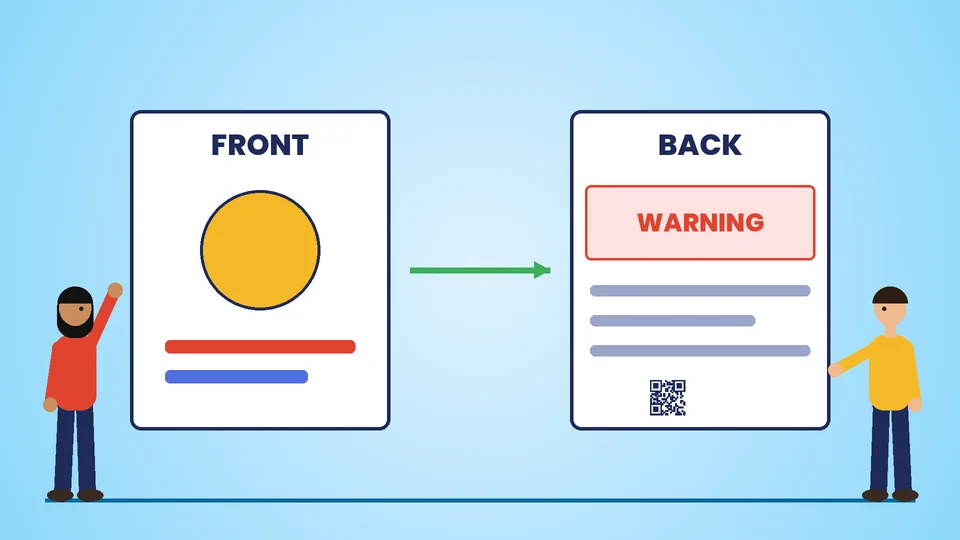
Once the required information is placed, the front label is where your brand does its work.
- Pick one focal point. That might be the brand name, an illustration or a bold color block. Don’t let three elements fight for attention.
- Use type that fits the price point and story. Classic serifs suggest tradition. Clean sans serifs and hand lettering suggest something newer. Our guide to brand fonts explains how to pick and pair typefaces.
- Use color with purpose. Bottle glass color changes how label colors look, so test them on the actual glass. Our guide to building a brand color palette covers choosing colors that work across a product line.
- Keep the brand recognizable across a range. Use a consistent layout and logo position, and vary color or illustration to tell the wines apart.
- Make sure images don’t mislead. TTB says images on wine labels may not create a misleading impression, for example about where the wine comes from.
Designing the back label
The back label carries most of the mandatory text, so it needs a clear structure:
- Tasting notes or a short story, if you include them, at the top.
- Mandatory statements grouped together, with the health warning set apart.
- Name and address, net contents and alcohol content where they’re easy to find.
- Barcode and any website or QR code at the bottom.
TTB notes that UPC barcodes are not regulated by TTB, and that website addresses and other digital links are allowed, but the pages they lead to are subject to TTB’s advertising rules.
Shape, paper and finishes
Wine labels are often where small producers spend on print effects. Common choices include:
- Textured or uncoated papers for a handmade feel.
- Foil stamping for brand names and borders.
- Embossing or debossing for a tactile logo.
- Die-cut shapes that break away from a plain rectangle.
- Wet-strength or water-resistant stock so labels survive an ice bucket.
Talk to your label printer early. They can tell you which papers hold up in a refrigerator, how much bleed to allow and how the label will be applied to the bottle. Our guide to ecommerce packaging design covers more on materials and print finishes.
Getting your label approved
TTB’s Anatomy of a Wine Label tool refers throughout to the Certificate of Label Approval, known as a COLA, that TTB issues for wine labels, so check with TTB which approvals your wine needs before it goes to market. The tool points out that some changes can be made without a new COLA, such as changing the vintage date or net contents, deleting or moving optional graphics, or changing digital content links. Adding or changing other optional information does require a new COLA.
For designers, that means two things. First, build the approved layout carefully, because late changes can mean resubmitting. Second, design a template system so you can update the vintage each year without touching the rest of the label.
Keep your label files organized, with editable source files and print-ready PDFs. Our guide to logo file formats explains which formats printers expect, and a brand style guide keeps every new label consistent.
Wine label design checklist
- Brand name on the brand label, not misleading.
- Class or type designation, with an appellation if required.
- Varietal percentages that add up to 100% if more than one grape is named as the type.
- Alcohol content written out in an accepted format, without “ABV” in the mandatory statement.
- Sulfite declaration if the wine has 10 ppm or more sulfur dioxide.
- Name and address that match the permit.
- Net contents in an approved standard of fill.
- Exact health warning, correctly formatted, at the right minimum type size.
- Colors and finishes tested on the actual bottle.
- Final files checked against the TTB mandatory information checklist before you apply for a COLA.
For other regulated product labels, see our guides to cosmetic label design and clothing label design.
Frequently asked questions
What information is required on a wine label in the United States?
Does the health warning have to be on the front label?
How big does the health warning text need to be?
Can I write “ABV” on my wine label?
Do I need a new label approval every vintage?
Can I put a QR code on a wine label?
Get a wine label designed for your brand
A strong wine label gets every required detail right and still makes someone pick the bottle up. Start with the TTB requirements, build a flexible layout, test on the real bottle and check everything before you apply for approval. If you need a wine label, a full product line or a brand identity for your winery, contact Pros Inc at 715 J St #200, San Diego, CA 92101, or call (858) 652-8920.