
Brand Voice Guide: How to Define and Write Your Voice
What is a brand voice guide?
A brand voice guide is a short document that describes how your business sounds in writing and in speech, with examples that people can copy. It names a few voice traits, explains how the tone shifts between situations, lists words you prefer and words you avoid, and shows before-and-after samples. Its purpose is consistency. When a website page, an email, an invoice reminder and a social post all sound like the same business, customers learn what to expect from you.
This guide shows how to build a brand voice guide in an afternoon, with a template, example wording rules and a review process. It is written for small businesses that do not have a full-time writer. Pros Inc builds voice guidelines alongside logos and style guides, and the steps below follow the same order we use with clients. None of this depends on special software, only on honest answers about how your business talks.
Voice and tone are not the same thing
The two words are often used as if they meant the same thing, and the difference matters.
- Voice is your business’s personality in writing. It stays the same everywhere. A voice might be “plain, warm and direct.”
- Tone is how that voice adjusts to the moment. You sound different when you announce a new service than when you apologize for a late delivery, but you are still recognizably the same business.
A useful comparison is a person who speaks differently at a celebration and at a funeral but is clearly the same person. Your guide should define the voice once and then give simple rules for adjusting the tone.
Step 1: Collect what you already write
Start with real material, not an empty page. Gather ten to twenty samples of your writing from different places:
- Website pages, including the home page and a service page
- Recent emails to customers and a few proposals
- Social media posts and replies
- Product descriptions or service summaries
- A complaint reply and a thank-you note
- Any text on packaging, signs or printed pieces
Read them in one sitting and mark what feels right, what feels stiff and what sounds like someone else. You will often find two or three different voices competing, such as a formal website and a casual social account. That is normal, and it is exactly what the guide fixes.
Step 2: Pick three voice traits
Choose three traits, no more. A long list is hard to remember and hard to apply. For each trait, write one sentence that says what it means and one that says what it does not mean. Pairing the trait with its limit stops it from turning into a caricature.
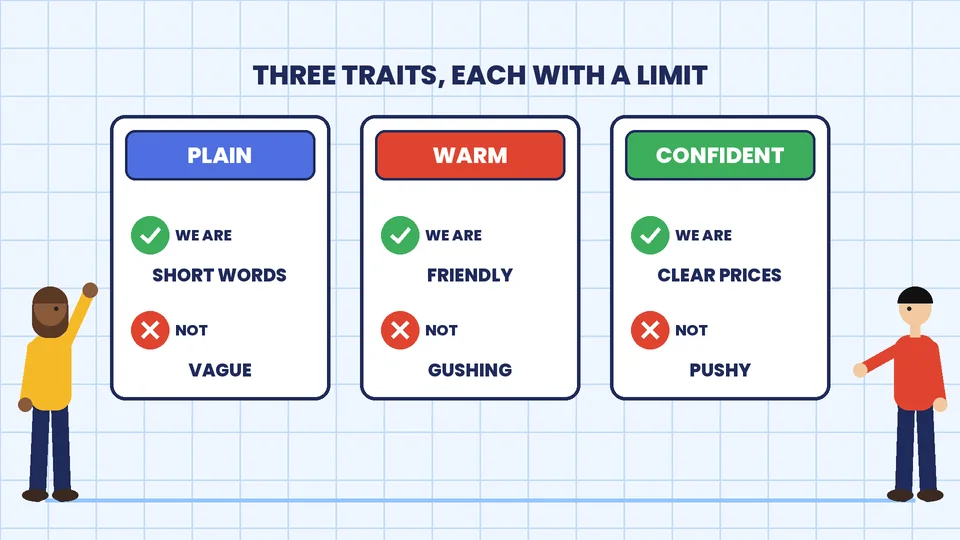
Here is the structure, with examples you can adapt:
| Trait | We are | We are not |
|---|---|---|
| Plain | Short sentences, everyday words, one idea at a time | Blunt, careless or vague |
| Warm | Friendly, patient, willing to explain | Chatty, gushing or over-familiar |
| Confident | Clear about what we do and what it costs | Boastful or pushy |
| Practical | Focused on steps, costs and results | Dry or full of jargon |
| Curious | Asks questions, shows interest in the customer’s work | Nosy or indirect |
Pick traits that are true of your business now, or that you are ready to practice. If your team is formal and precise, a “playful” voice will sound forced. A voice that matches how people actually behave is easier to keep up.
Step 3: Define how tone shifts
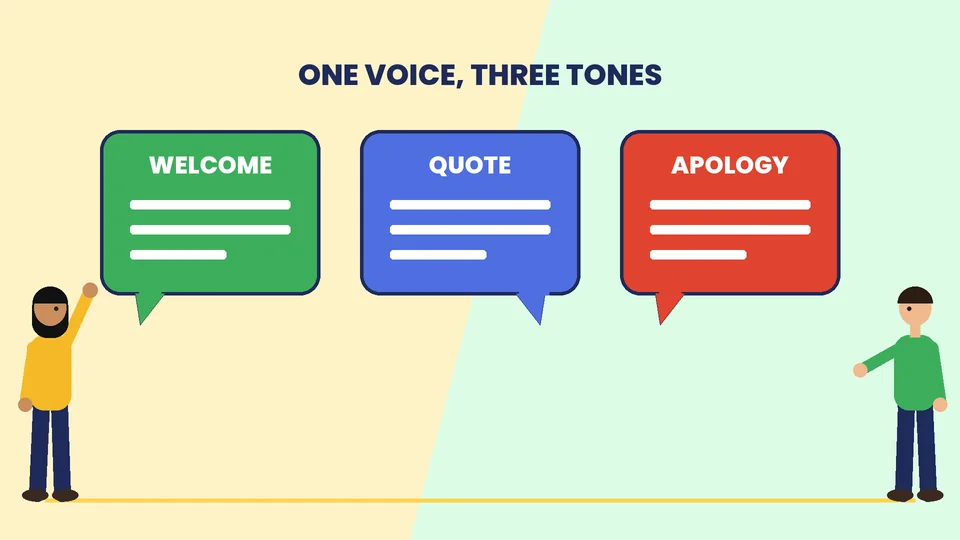
Next, describe how the voice flexes in the situations you meet most often. A short table is enough:
| Situation | Tone | Example opening |
|---|---|---|
| Welcoming a new customer | Warm and clear | “Thanks for choosing us. Here is what happens next.” |
| Sending a quote | Confident and specific | “The project costs a fixed amount, and this is what it covers.” |
| Late delivery or a mistake | Calm, direct and accountable | “We are late. Here is why and when you will have it.” |
| Reminding about an invoice | Polite and brief | “A quick reminder that invoice 123 is due on Friday.” |
| Announcing news | Upbeat but plain | “We have a new service for restaurants.” |
| Replying to a complaint | Patient and practical | “I’m sorry this happened. Here is how we will fix it.” |
Write three to six rows that match your business, and add a real example from your own messages for each. Examples are more useful than adjectives, because they show a new team member exactly what to do.
Step 4: Set word and style rules
This is the part that makes the guide usable day to day. Keep it to one page. A good rule list covers:
- Words we like. The terms you use with customers, such as “project,” “client” or “order,” and the product names spelled the way you want.
- Words we avoid. Jargon, buzzwords, and phrases that sound like every other company. A simple list of ten is enough.
- Person and address. Whether you write “we” and “you,” whether you refer to the business in the third person, and whether you use first names.
- Sentence length. For example, “most sentences under 20 words.”
- Punctuation and format. Whether you use exclamation points, emoji, contractions and the serial comma.
- Capitalization. How you write job titles, product names and headings.
- Numbers, dates and currency. One format for each, used everywhere.
- Accessibility. Plain language, descriptive link text and short paragraphs help every reader.
Contractions are a quick way to set the register. “We’re” sounds friendlier than “we are,” and “we are” can sound more formal. Choose one and apply it consistently.
Step 5: Add before-and-after examples
Examples do more work than any list of rules. For each trait, write one sentence in the way you do not want to sound and a rewrite in your voice.
| Before | After |
|---|---|
| “We utilize our expertise to deliver solutions.” | “We design logos and print materials, and we explain each choice.” |
| “Your request is being processed.” | “We have your request and will reply by Friday.” |
| “Please be advised that payment is overdue.” | “Invoice 123 is now past due. Can you let us know when to expect payment?” |
| “We are thrilled to announce our new offering!!!” | “We now offer a monthly design plan for small teams.” |
Use rewrites from your own samples. They remind you of the habits you most need to change, and they help anyone who joins later to learn your voice quickly.
Step 6: Connect voice to your visual identity
Voice is part of your brand identity along with your logo, colors and fonts, and it should feel like it belongs with them. A serious, traditional logo paired with jokes in every email can feel mismatched, and a playful, colorful identity paired with stiff legal language has the same problem.
Place the voice guide next to your brand style guide so that visual and written rules live together. If you are still creating the visual side, a clear logo design brief is a good place to record how you want the brand to feel, and the same adjectives can feed the voice traits.
If your brand includes a character or mascot, give it a voice rule of its own. Our guide to brand mascot design explains how to keep a character consistent.
Step 7: Apply the voice where customers read you
A guide that sits in a folder will not change anything. Pick the places where your writing reaches customers and update them in order of traffic:
- Website home page and main service pages. Rewrite headlines and opening paragraphs first. If you are planning a larger update, see our website redesign checklist.
- Landing pages and calls to action. Keep button text short and specific. Our guide to landing page design covers the layout side.
- Email templates. Update the welcome message, quote, invoice and follow-up. See email newsletter design and email signature design for the format.
- Presentations and proposals. Match the voice in headings and summaries, as described in our pitch deck design guide.
- Social profiles and bios. Use the same short description everywhere.
- Automatic messages. Order confirmations, error pages and out-of-office replies are easy to forget and are read by many people.
Keep the guide short and alive
A voice guide works best at two to four pages. Anything longer will not get read. Keep it practical:
- Put it where people work. Share it in the same folder or tool as templates, and link to it from your onboarding notes.
- Teach with examples. Add new before-and-after samples as you find them.
- Review twice a year. Look at recent emails and posts, and adjust any rule that no one follows.
- Name one owner. One person should answer questions about the guide and approve changes.
- Let customers tell you. If customers keep asking the same question, your wording may be unclear. Fix the wording and record the fix.
Common brand voice mistakes
- Choosing aspirational traits. A voice you cannot keep up will drift back to your old habits within weeks.
- Writing a long list of adjectives. Without examples, “friendly” means something different to everyone.
- Copying a larger brand. Their voice fits their audience, not yours.
- Ignoring tone. Using the same cheerful voice for a complaint reply feels tone-deaf.
- Keeping it secret. If only one person has read the guide, it will not change anything.
- Forgetting existing material. Old pages with the previous voice make the brand feel inconsistent.
Brand voice guide checklist
- Have you collected at least ten real writing samples?
- Did you choose three voice traits, each with a “we are not” limit?
- Did you describe how tone changes in at least four situations?
- Do you have lists of words you like and words you avoid?
- Are person, sentence length, punctuation and number formats defined?
- Do you have at least four before-and-after examples?
- Does the voice match your logo, colors and fonts?
- Is the guide stored where people will find it?
- Have you updated the website, email templates and automatic messages?
- Is there one owner and a twice-yearly review?
Frequently asked questions
What is the difference between brand voice and tone?
How many voice traits should a brand have?
How long should a brand voice guide be?
Who should write the brand voice guide?
Do I need a brand voice guide if I am the only writer?
How often should I update my brand voice guide?
Put your brand voice into practice
Collect your own writing, pick three traits, add tone rules and examples, and then update the pages and templates customers see most. If you want help creating a voice guide that matches your logo and style guide, contact Pros Inc at 715 J St #200, San Diego, CA 92101, or call (858) 652-8920.